

Céline Goole
•
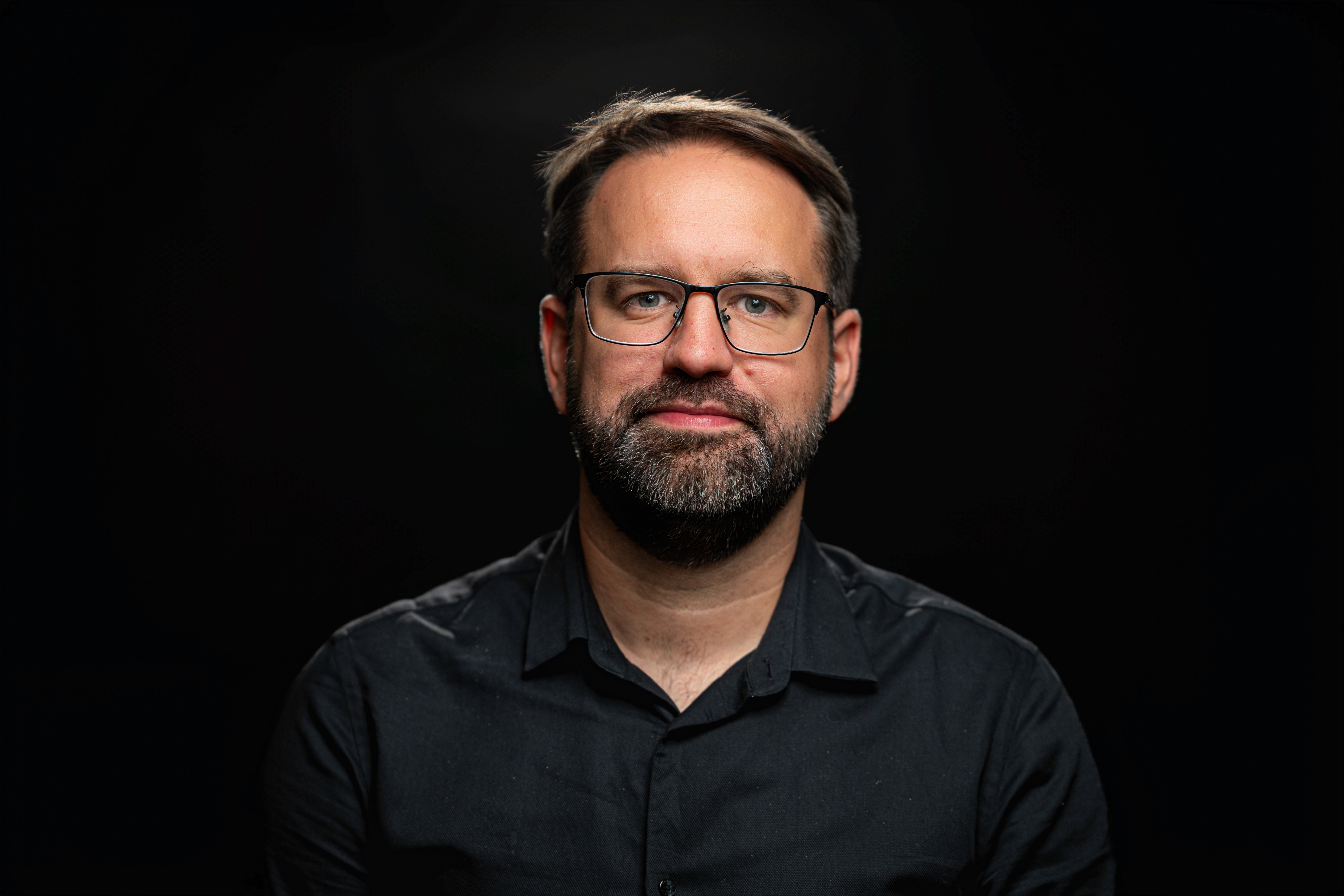
What does composing a piece of music have in common with preparing a great sauce or writing software? Quite a lot, apparently. Julio, developer at Hatch, has followed a rather unconventional career path, taking him from a music conservatory in Brazil to restaurant kitchens in Leuven, before eventually landing in software development.
A career path that wasn't exactly planned
Growing up in Brazil, music was always part of his life. His father played the piano, and when Julio turned ten, he enrolled in a conservatory to learn the violin. For the next eleven years, music would remain a constant in his life, eventually bringing him to Belgium at the age of 21, where he went on to study musicology at KU Leuven.
But moving abroad as a student also meant finding a way to pay the bills, and that's where things took an unexpected turn. Julio started working in a restaurant in Leuven. He didn't exactly walk into the kitchen as an aspiring chef. In fact, he started where many people in hospitality start: washing dishes, helping out with smaller tasks and gradually learning how things worked.
Over time, though, he became increasingly involved in the kitchen, picked up cooking techniques from the chefs around him and discovered that he genuinely enjoyed it. What began as a practical way to finance his studies turned into almost ten years of experience in hospitality, working in different restaurants and developing a passion that has stayed with him ever since. At one point, he even considered switching from musicology to culinary school. Still, music remained his main focus, at least academically. Until the pandemic arrived and Julio, who was finishing his master's degree at the time, started questioning what he wanted to do next.
Finding a job as a musicologist wasn't looking particularly promising, and although technology had always interested him, he'd never really considered it a career he could pursue. A friend eventually suggested BeCode, a Belgian coding bootcamp that helps people transition into technology careers.
Six months of intensive training and an internship at a small startup later, Julio had landed his first job as a developer. He stayed there until he eventually joined Hatch. And that's how someone who spent most of his childhood playing classical music, and a good part of his twenties working in restaurant kitchens, ended up writing software for a living.
Which naturally raises a question. Are these three disciplines really as different as they seem?
Maybe we've been looking at creativity the wrong way
At first glance, music, cooking and coding don't seem to have all that much in common.
Music and cooking are generally associated with intuition, expression and experimentation, while coding tends to be perceived as something far more structured. There are programming languages, technical requirements, architectures and all kinds of rules that determine what you can and cannot do. Of course, there's creativity involved in software development, but surely it's a different kind of creativity? Julio sees it differently.
"One thing I always liked about music was composing, not just playing. And I think people sometimes forget that music is actually very structured."
Good point. We tend to associate music with emotion and spontaneity, but underneath every composition lies a sophisticated system of rhythms, harmonies, scales and patterns. You can improvise, experiment and create something completely unexpected, but there's usually a foundation of musical knowledge that makes those creative decisions possible in the first place.
The same applies to cooking. "If you're just being creative, your cake is going to be crap.It's also about understanding why certain ingredients work together, what happens when you change a proportion and how different techniques affect the outcome.” And that's where the connection to software development becomes interesting.
Structure doesn't kill creativity. It enables it.
There's a tendency to think of rules and structure as things that limit creativity, as if the most creative people are those who operate without constraints and simply follow wherever their imagination takes them.
But Julio's perspective challenges that assumption in a rather interesting way. Because perhaps creativity isn't about having unlimited freedom. Perhaps it's about having enough knowledge, experience and understanding to make something meaningful within a given set of possibilities.
A musician who understands harmony can deliberately introduce tension into a composition. A chef who knows how ingredients interact can experiment with combinations that might seem unusual at first. And a developer who understands the principles behind a software architecture can explore different approaches to solving a problem, rather than simply following the first solution that comes to mind.
In all three cases, the fundamentals don't determine what you create. They give you a starting point from which to explore. And the more comfortable you become with those fundamentals, the more freedom you actually have.
That's particularly relevant in software development, a profession that still suffers from the perception that it's primarily about logic, precision and writing technically correct instructions. Of course, those things matter. Software needs to work, after all. But anyone who's been involved in building digital products knows that there's rarely just one correct way to approach a problem. There are countless decisions to make along the way, from how you structure a system to how you translate a complex requirement into something simple and intuitive.
And while some of those decisions are driven by technical constraints, many require exactly the kind of creative thinking we tend to associate with more artistic disciplines. You explore possibilities, test assumptions, make mistakes, reconsider your approach and gradually work towards something that feels right. Which, when you think about it, isn't all that different from composing a piece of music or developing a new recipe.
And then there's AI, which changes the rules again
Of course, with AI increasingly finding its way into everything from software development to music production, it's worth wondering what happens to these creative disciplines when technology can take over some of the work that traditionally required years of practice and expertise.
Julio approaches this evolution with curiosity rather than scepticism. While he finds it difficult to imagine AI ever truly replacing the human experience of making music, he certainly sees its potential as a creative companion.
"I think generating music with AI can be a really fun thing. And using AI as an assistant when composing could also be interesting. It has a lot of knowledge and might give you insights you wouldn't necessarily have thought of yourself."
The same reasoning applies to coding, where AI is already changing how developers work, experiment and solve problems. But there's an interesting distinction between being able to generate something and actually understanding what makes it good, whether that's a piece of software, a musical composition or a recipe.
And perhaps that's where Julio's earlier point about mastering the fundamentals becomes even more relevant. As AI makes the execution increasingly accessible, the ability to make informed creative decisions, recognise quality and know when something needs a different approach might become more valuable than ever.
Three passions, one creative mindset
When asked which of his three passions he'd choose if he could only keep one, Julio laughs and compares it to having to choose a favourite child. Although coding has been taking up much of his free time lately, he wouldn't want to give up music or cooking either.
And perhaps that's because, despite the very different paths that brought him to each discipline, they all seem to satisfy a similar curiosity: understanding how things work, getting better at them and eventually reaching a point where there's enough confidence and knowledge to start experimenting.
Julio's story is also a nice reminder of how easily we tend to categorise people and professions as either creative or technical, intuitive or analytical, when in reality those qualities aren't mutually exclusive at all. If anything, some of the most interesting work happens when they come together.
Schedule a meeting
or reach out
Book a 30 min
Introduction Meeting
info@hatch.be
+32 471 07 74 16
Interleuvenlaan 15A
3001 Leuven (Belgium)
What does composing a piece of music have in common with preparing a great sauce or writing software? Quite a lot, apparently. Julio, developer at Hatch, has followed a rather unconventional career path, taking him from a music conservatory in Brazil to restaurant kitchens in Leuven, before eventually landing in software development.

World Models aren't new, but the technology is getting considerably more interesting. Here's what Google's latest development tells us about the future of digital products, and why we might want to look beyond screens and features.